
VoIP Phone System UK
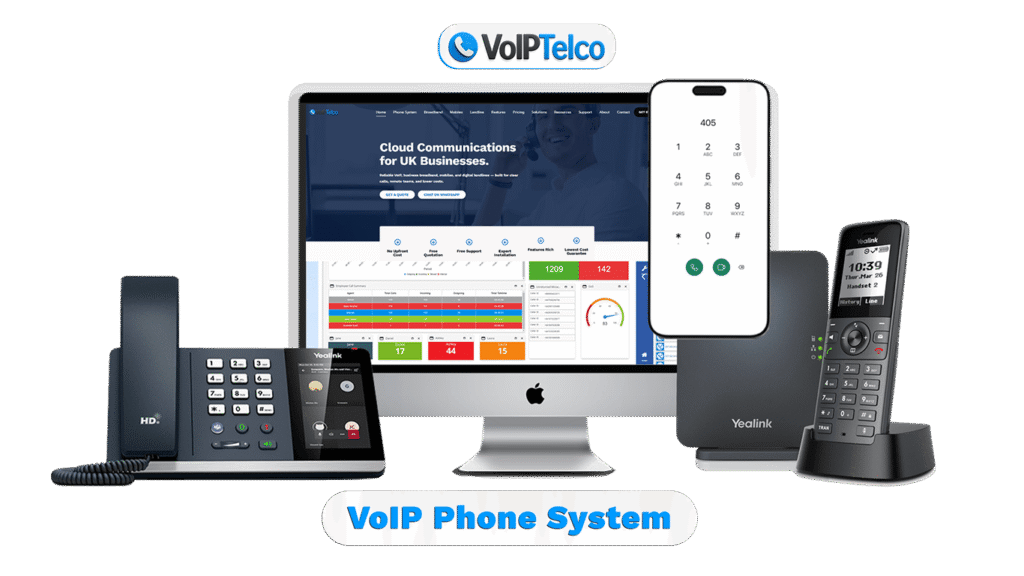
A VoIP phone system is a cloud-based telephony service that lets businesses make calls over the internet instead of using traditional phone lines. It converts voice into digital packets, reduces costs, improves flexibility, and includes features like call routing, IVR, recording, and CRM integrations.
PSTN Switch-Off Ready (2027)
Lower Costs Than On-Premise PBX
Works on Desk Phones, Laptops & Mobiles
Designed for SMEs, Multi-Site & Remote Teams
What is a VoIP Phone System?
A VoIP phone system, or Voice over Internet Protocol phone system, is a modern communication solution that allows you to make and receive calls using the internet rather than traditional telephone lines. Instead of relying on copper wires or analogue signals, VoIP converts your voice into digital data and transmits it securely over your broadband connection.
This technology offers a range of benefits, including cost savings, flexibility, and advanced features such as call forwarding, voicemail-to-email, and video conferencing. VoIP systems are highly scalable, making them ideal for both small businesses and large enterprises. With a VoIP phone system, you can stay connected from anywhere in the world, provided you have an internet connection. It’s a smart choice for anyone looking to modernise their communications and reduce costs without compromising on quality or reliability.
Why UK businesses choose VoIP
• Lower monthly phone bills
• Easy to scale across locations
• Works anywhere with internet
• Enterprise-grade features without hardware
• Perfect for hybrid and remote teams
How does a VoIP Phone System Work?
A VoIP (Voice over Internet Protocol) phone system works by converting your voice into digital signals and transmitting them over the internet, rather than through traditional telephone lines. When you speak into a VoIP-enabled device, your voice is broken down into small data packets. These packets are then sent over your broadband connection to the recipient, where they are reassembled into sound.
One of the main advantages of a VoIP phone system is its flexibility. You can make and receive calls from anywhere with an internet connection, using a computer, smartphone, or dedicated VoIP handset. This makes it ideal for remote working and businesses with multiple locations.
VoIP systems also offer a range of advanced features such as voicemail-to-email, call forwarding, video conferencing, and integration with other business tools. Additionally, because calls are routed via the internet, costs are typically much lower than traditional phone services, especially for long-distance or international calls.
In summary, a VoIP phone system provides a reliable, cost-effective, and feature-rich solution for modern communication needs. It’s a smart choice for anyone looking to upgrade their business communications.
1. You speak into your VoIP phone, laptop, or mobile app.
2. Your voice is converted into digital packets.
3. Packets travel over your secure internet connection.
4. The VoIP platform routes the call to the destination number.
5. The receiver hears your voice in real time.
This simple process delivers HD audio, lower costs, and greater flexibility than legacy phone systems.
The Problem: Legacy Phone Systems Holding Your Business Back
If your business still relies on ISDN lines or outdated PBX hardware, you’re facing mounting challenges that directly impact productivity and profitability. The UK’s PSTN switch off deadline approaches in January 2027, forcing businesses to transition to IP based telephony. Beyond regulatory pressure, legacy systems create daily operational friction:
Symptoms your phone system is failing you
Poor call handling costs UK SMEs an estimated 15–20% in lost opportunities; inflexible systems add £200–£500 per employee annually in wasted time.
The Solution: Cloud-Hosted VoIP Built for Modern UK Business
A cloud VoIP system replaces expensive hardware with a scalable, feature-rich, UK-hosted platform that grows with your organisation.
🔥 Core Features & Benefits
Advanced Call Routing & IVR
Multi level auto attendants; time based and skills based routing. Overflow/failover rules so no call is missed.
Enterprise Call Recording & Compliance
Record by user/queue/number; DTMF masking; pause/resume. Searchable recordings with 30/90/365 day retention.
AI Powered Call Intelligence
Live transcription; sentiment; searchable library. Quality scoring, coaching alerts; trend dashboards.
Unified Communications
Softphones (Win/Mac/iOS/Android); IP desk phone compatibility. Presence, IM, video, screen share.
Microsoft Teams Integration
Operator Connect & Direct Routing; keep numbers; unified admin.
CRM & Helpdesk Integrations
Click to dial, screen pops, auto logging (Salesforce, HubSpot, Zendesk, etc.).
Scalable Architecture
Add/remove users in minutes; multi site management; UK/international numbers.
Analytics & Reporting
Customizable dashboards; call volume, agent performance, and SLA metrics. Exportable reports for compliance and business insights.
Security & Reliability
End‑to‑end encryption; GDPR-ready data handling. 99.99% uptime SLA with geo‑redundant hosting and disaster recovery.
VoIP Phone System Pricing (Transparent & Scalable)
| Plan | Monthly Price | Best For | Key Features |
| Basic | £9.99/user | Startups | HD Voice, Mobile App, Voicemail |
| Business | £14.99/user | Growing SMEs | Routing, IVR, Call Recording |
| Enterprise | £19.99/user | Large Teams | Analytics, CRM, Compliance, Integrations |
VoIP vs Traditional Landline: What’s the Difference?
| Feature | VoIP Phone System | Landline/PBX |
| Cost | Low | High (hardware + maintenance) |
| Scalability | Instant | Slow, on-site work required |
| Remote Work | Fully supported | Limited |
| Call Features | Advanced (IVR, routing, analytics) | Basic |
| Integrations | Yes | No |
| PSTN Switch-Off Ready | ✔ Yes | ✘ No |
How It Works: Implementation Journey
Step 1 — Discovery & Requirements (Week 1)
Map usage, must haves, compliance, connectivity (≈100 kbps per concurrent call), rollout plan, number inventory.
Deliverable: Implementation plan with timeline, device recs, success criteria.
Step 2 — Number Porting & Testing (Weeks 2–4)
Submit ports; schedule outside business hours; provide test DDIs; configure flows; admin training.
Deliverable: UAT ready test environment; confirmed port date.
Step 3 — Go Live & Onboarding (Weeks 4–5)
Cutover with 24/7 support; activate devices/apps; user training; monitor QoS; deploy integrations.
Deliverable: Live system with users migrated and integrations active.
Step 4 — Optimisation & Support (30/60/90 Days)
30 day analytics review; 60 day advanced features; 90 day QBR + optimisation; ongoing UK support.
Deliverable: Tuned setup aligned to KPIs with runbooks and reviews.
VoIP Phone System Technical Specifications
Network & Connectivity
Requirement | Specification | Notes |
|---|---|---|
Minimum Bandwidth | 100 kbps / concurrent call | Up/Down; G.729 |
Recommended Bandwidth | 100–150 kbps / call | G.711 for HD |
Latency | < 150 ms one way | < 75 ms ideal |
Jitter | < 30 ms | Consistent timing |
Packet Loss | < 1% | Above degrades quality |
QoS (DSCP) | EF (Expedited Forwarding) | Prioritise voice |
Connection guidance
- 1–10 users: FTTP/SOGEA ≥40 Mbps
- 11–50 users: FTTP ≥100 Mbps or bonded + failover
- 50+ users: Leased line or dual circuit FTTP + auto failover
- All: 4G/5G backup for continuity
Protocols & Codecs
Signalling: SIP; media via RTP/SRTP; TLS 1.2+ for encrypted signalling
Audio codecs:
Codec | Bitrate | Use Case | Quality |
|---|---|---|---|
G.711 (A law) | 64 kbps | UK standard HD | Excellent |
G.729 | 8 kbps | Low bandwidth | Good |
G.722 | 64 kbps | Wideband HD | Excellent |
Opus | 6–510 kbps | Adaptive/modern | Excellent |
NAT traversal: STUN; support for symmetric NAT and restrictive firewalls
Devices & Apps
Desk phones: Yealink T series; Polycom VVX; Cisco 7800/8800; Grandstream GRP; Snom D
Softphones: Desktop (Win/Mac), Mobile (iOS/Android), Web (Chrome/Edge/Safari)
Headsets: USB/Bluetooth (Poly, Jabra, Sennheiser); RJ 9 via desk phones
Power & Redundancy
PoE: 802.3af for desk phones; UPS recommended
Mobile failover: via apps; platform with UK data centre geo redundancy
Pricing & Investment Framework
Cost components
- Per user licensing (monthly)
Essential / Professional / Enterprise (AI, recording, analytics, integrations).
Typical range: £12–£35 per user/month. - Calling packages
UK unlimited; international add ons or PAYG; premium numbers at cost. - Numbers
Geographic: £1–£3/mo; Non geographic: £5–£15/mo; Porting: £5–£10 one off (often waived). - Devices (one time)
Desk phones: £60–£400; conference phones: £300–£800; softphones included. - Professional services (one time)
Standard impl. included for 10+ users; integrations £500–£2,000+; custom dev quoted.
ROI indicators (25 user SME)
- Save 40–60% vs ISDN/PBX monthly costs
- Avoid £3k–£8k upfront hardware
- Reduce missed calls 25–40% (recover £10k–£30k/yr)
- Save 15–20 hrs/agent/month via CRM automation
- Payback: typically 6–12 months
Get a Quote for pricing tailored to users, volumes, and integrations.
Compliance & UK Regulatory Requirements
Emergency Calling (999/112)
VoIP calls to 999/112 supported with location data. During power/broadband outages, VoIP may be unavailable. For at risk users or critical services, use UPS and mobile failover; always keep an alternative method to contact emergency services.
Data Protection & GDPR
- DPA provided; UK data residency for recordings/metadata
- Encryption: TLS 1.2+ signalling; optional SRTP; AES 256 at rest
- RBAC, DSAR tools, configurable retention (30/90/365), audit logs
PECR
Recording announcements; CLI control; TPS integration for marketing calls
Ofcom
Streamlined switching/porting; CLI hygiene; compliant emergency routing; 99.9% SLA monitoring
Sector specific
- FCA: recording, tamper proof storage, 7 year retention, audit retrieval
- ICO/Healthcare/Legal: per user/queue recording policies; DTMF masking; pause/resume
Accessibility
Support for Relay UK and 999 BSL; accessible device/account options on request
PCI safe recording
Use DTMF masking and pause/resume to avoid capturing card data
AI transcription & processing
Enable per user/queue; choose retention; export via admin portal consistent with Privacy Policy
Comparisons
VoIP vs Legacy ISDN/PBX
Factor | VoIP Phone System | Legacy ISDN/PBX | Winner |
|---|---|---|---|
Upfront Cost | Low (£0–£500/user) | High (£5k–£20k+ hardware) | VoIP |
Monthly Cost | £12–£35/user + calls | £30–£60/user + lines + calls | VoIP |
Scalability | Instant via portal | Engineer visit + hardware | VoIP |
Remote Work | Native apps | Add ons/limited | VoIP |
Analytics | Real time + AI | Manual/expensive add ons | VoIP |
Integrations | CRM/Teams/helpdesk | Limited/middleware | VoIP |
Maintenance | Provider managed | On site contracts | VoIP |
Continuity | Multi device + failover | Single point of failure | VoIP |
Updates | Continuous | Costly upgrades | VoIP |
Compliance | Built in | Bolt ons | VoIP |
Setup Time | 2–4 weeks (incl. porting) | 6–12 weeks | VoIP |
PSTN Risk | Future proof | Must migrate by 2027 | VoIP |
VoIPTelco vs Other Cloud Platforms
Feature | VoIPTelco | Generic UCaaS | Video First (Zoom/Teams) |
|---|---|---|---|
Core Strength | Enterprise voice + AI analytics | Collaboration focus | Video + messaging |
UK Numbers | Full geo/non geo | Often limited | Often add on |
Call Centre | Built in | Add on/separate | Basic/NA |
Porting | Handled end to end | Self serve/partner | Complex/3rd party |
Compliance | FCA/ICO ready | Varies | Often lacking |
SLA/Support | 99.9% UK support | Varies/offshore | Best effort/premium |
Best For | SMEs needing reliable voice + analytics | Chat/video first teams | Light call volumes |
Proof & Performance (Indicative Outcomes)
Efficiency: 30–50% fewer abandoned calls; 20–35% better first call resolution; 15–25% lower handle time
Costs: 40–60% telecom savings; £3k–£8k capex avoided; 70–80% cheaper international calls
Continuity: ≥99.5% user reported uptime; zero downtime during moves; 90%+ staff continuity via softphones
Compliance: 100% recording compliance (with correct config); 50–70% faster retrieval; zero ICO penalties
Revenue: £10k–£30k/yr recaptured; 15–20% faster lead response; 25–40% higher call conversion (with AI coaching)
Implementation Timeline & Next Steps
30/60/90 Day Plan
- Days 1–30: Discovery, network assessment, number audit → ports submitted, UAT env, admin training → cutover + onboarding
- Days 31–60: Analytics review, AI transcription, advanced IVR/queues, CRM workflows
- Days 61–90: QBR + ROI analysis, cost optimisation, roadmap for next phase
Your Next Steps
- Book a Demo — see the platform with your use cases
- Get a Quote — tailored to users, volumes, integrations
- Start Porting — secure your cutover date
- Call Sales — speak to a VoIP specialist
Frequently Asked Questions
Ready to Transform Your Communications?
Take the next step towards a more efficient, scalable, and future-proof phone system. Contact us today.
UK based provisioning & support. Keep your numbers. Zero downtime porting windows. SLA backed voice quality and uptime. Works with Teams, softphones, and IP desk phones.